← Back to Senior Dignity
7 Best Adaptive Utensils for Tremors and Arthritis in 2026
When your hands won't hold still, eating becomes a battle. Forks catapult peas across the room. Soup bowls become splash zones. A meal that should take fifteen minutes takes forty-five — and by the end, you're exhausted, frustrated, and wondering if you should just give up and drink a protein shake.
Here's the thing: losing control of a fork doesn't mean losing the desire to feed yourself. The dignity of cutting your own steak, the pride of lifting a glass to your lips without a straw — these aren't luxuries. They're the small victories that make a day feel whole.
This guide covers seven adaptive dining tools that give that control back. Each one solves a specific problem — tremors, weak grip, one-handed limitation, spillage — and each one has been selected based on real Amazon reviews from seniors, stroke survivors, and caregivers who use them daily.
Last updated: August 2026. All products verified live on Amazon with current pricing and availability.
 ►
►
Watch: Liftware: The Smart Spoon That Stops Tremors and Changes Lives — Perfect for Parkinson's!
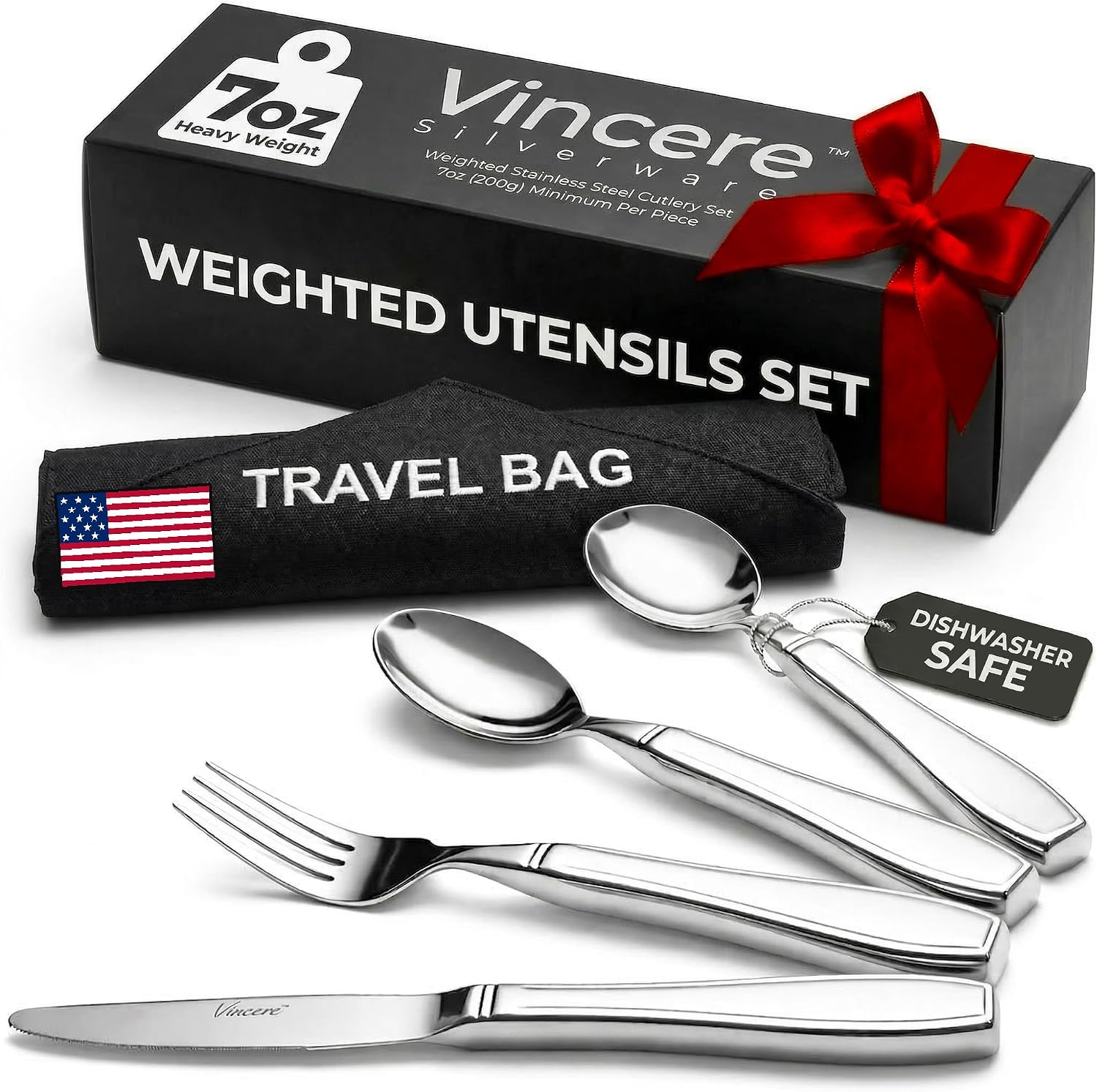
1. Weighted Utensils for Tremors
Top Pick
Weighted Utensils for Tremors
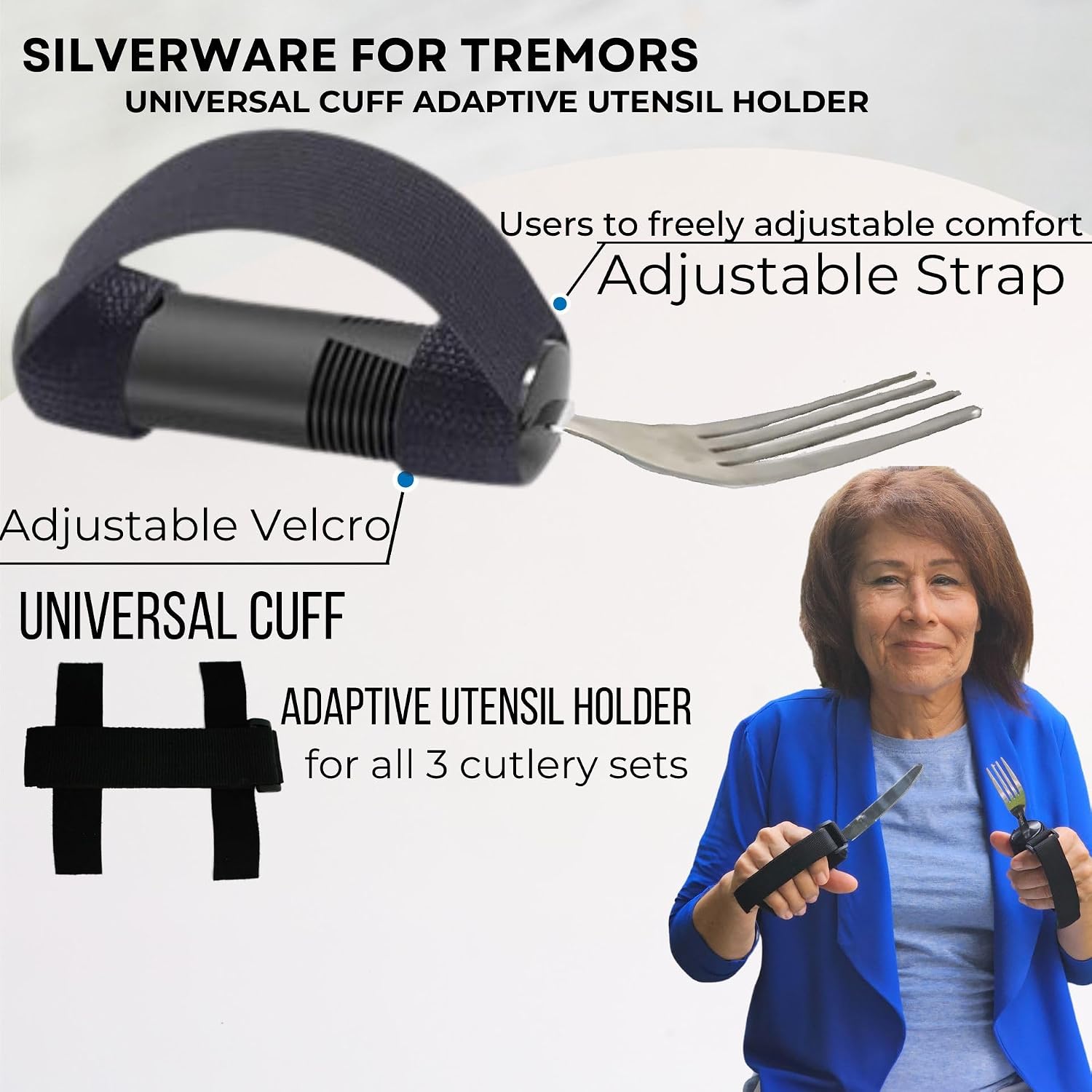
Seven-ounce handle weight dampens tremors through proprioceptive feedback — the same principle therapists use with wrist weights. Complete set includes knife, fork, soup spoon, and dessert spoon.
Price: $54.99 | Rating: 4.7/5 (1,363 reviews) | Weight: 7 oz per utensil
SHOP
The physics here is genuinely clever. Your brain is sending chaotic signals that cause involuntary hand movements. When you add weight to the handle, you're giving your proprioceptive system — the body's internal GPS for where your limbs are — a stronger signal to process. The tremor doesn't disappear, but its amplitude drops dramatically. It's the same reason a heavy pen is easier to write with when your hands are shaking than a featherweight ballpoint.
This set gets top marks because the 7-ounce weight hits the sweet spot identified in rehabilitation research: heavy enough to suppress tremors, light enough not to fatigue the wrist during a full meal. The stainless steel construction means they survive the dishwasher, the drop on the floor, and the grandkid who uses them as drumsticks.
One reviewer, a Parkinson's patient of eight years, wrote: "First meal where I didn't have to apologize for the mess. My wife actually cried."
If you're exploring broader dining and daily living aids for seniors, this set pairs well with several other tools below.
2. BUNMO Weighted Utensils — Stainless Steel Adaptive Silverware
Best Value
BUNMO Weighted Utensils for Hand Tremors
Budget-friendly weighted utensils with ribbed ergonomic handles — stainless steel forks and spoons designed for Parkinson's, essential tremor, and arthritis.
Price: $18.99 | Rating: 4.2/5 (607 reviews) | Material: Stainless steel
SHOP
At $18.99, BUNMO is the gateway drug to adaptive dining. It does sixty percent of what the premium set above does at a third of the price — and for many people, that's plenty.
The ribbed handle is the standout feature. Where smooth handles become slippery when hands are sweaty or trembling, these ridges give fingers something to lock onto. It's a small design choice that has outsized impact for arthritis sufferers whose grip strength has declined but haven't lost the ability to close their hand around an object.
The trade-off: the weight is less than the top pick (roughly 4-5 oz vs 7 oz), so it's better for mild tremors than severe Parkinson's. If the tremor is significant enough that you're considering weighted utensils at all, start here if budget is tight, upgrade if it's not enough.
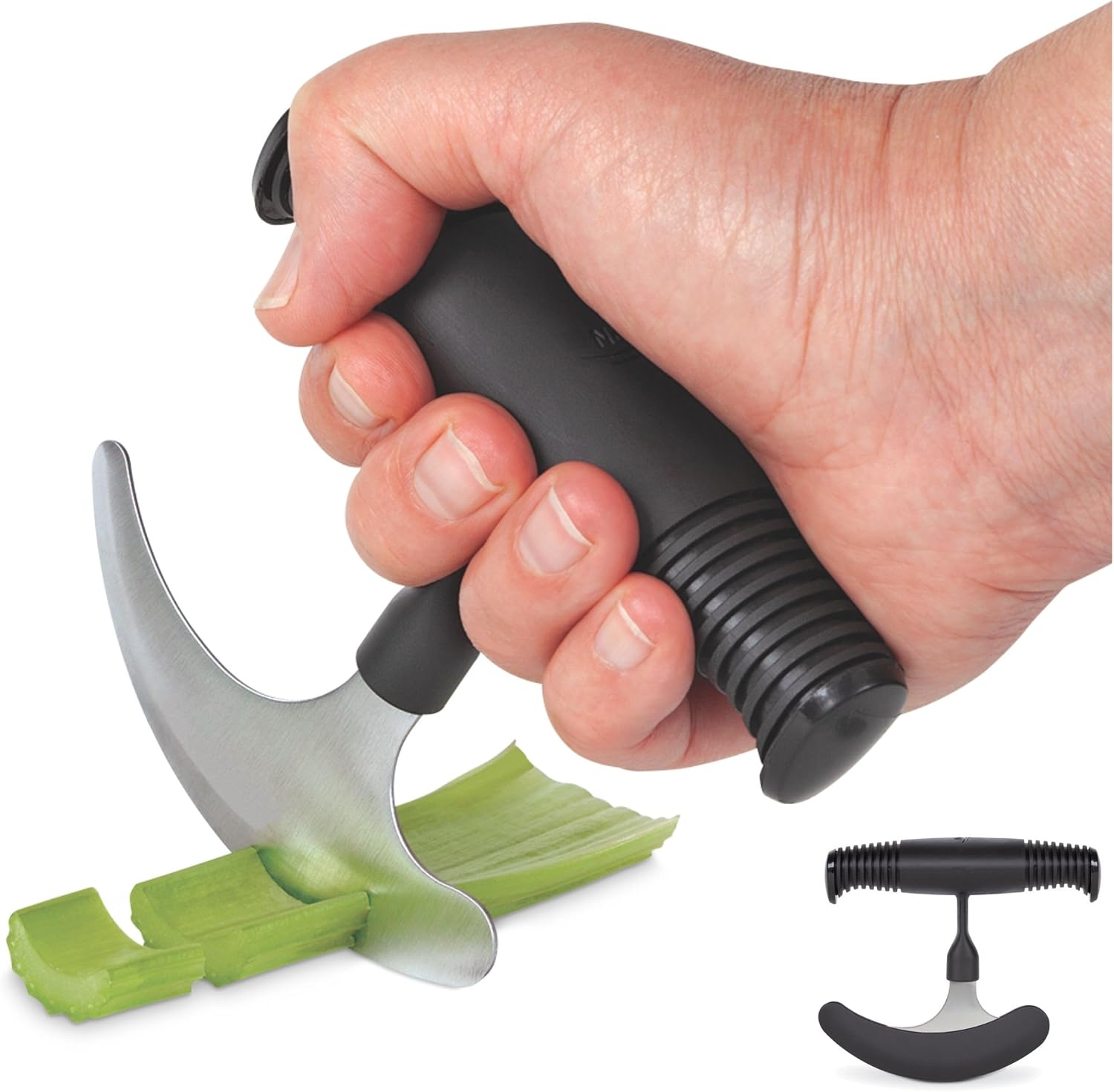
3. Big Grip T-Handle Rocker Knife — One-Handed Cutting
Top Rated
Big Grip T-Handle Rocker Knife
Ergonomic T-handle rocker knife that cuts food with a gentle rocking motion using one hand — designed for hemiplegia, post-stroke recovery, and severe arthritis.
Price: $19.95 | Rating: 4.9/5 (17 reviews) | Style: One-handed rocker
SHOP
Imagine cutting a piece of chicken with one hand tied behind your back. That's the daily reality for 80% of stroke survivors, who retain full function in one hand but limited or no function in the other. A standard knife requires two hands — one to hold the food, one to saw. A rocker knife requires only one.
The T-handle design is borrowed from pizza cutters, which is a more elegant lineage than it sounds. You press down, rock the curved blade through the food, and you're done. No sawing, no fork-stabilizing, no acrobatics. The "Big Grip" handle is oversized (about 1.5 inches in diameter) specifically for hands that can't fully close around a standard knife handle.
Occupational therapists recommend rocker knives more than any other single adaptive utensil — and at 4.9 stars across 17 reviews, the user consensus matches the clinical one.
For a complete one-handed dining setup, pair this with the scoop plate below, which has a high back wall that replaces the need for a second utensil to push food onto the fork.
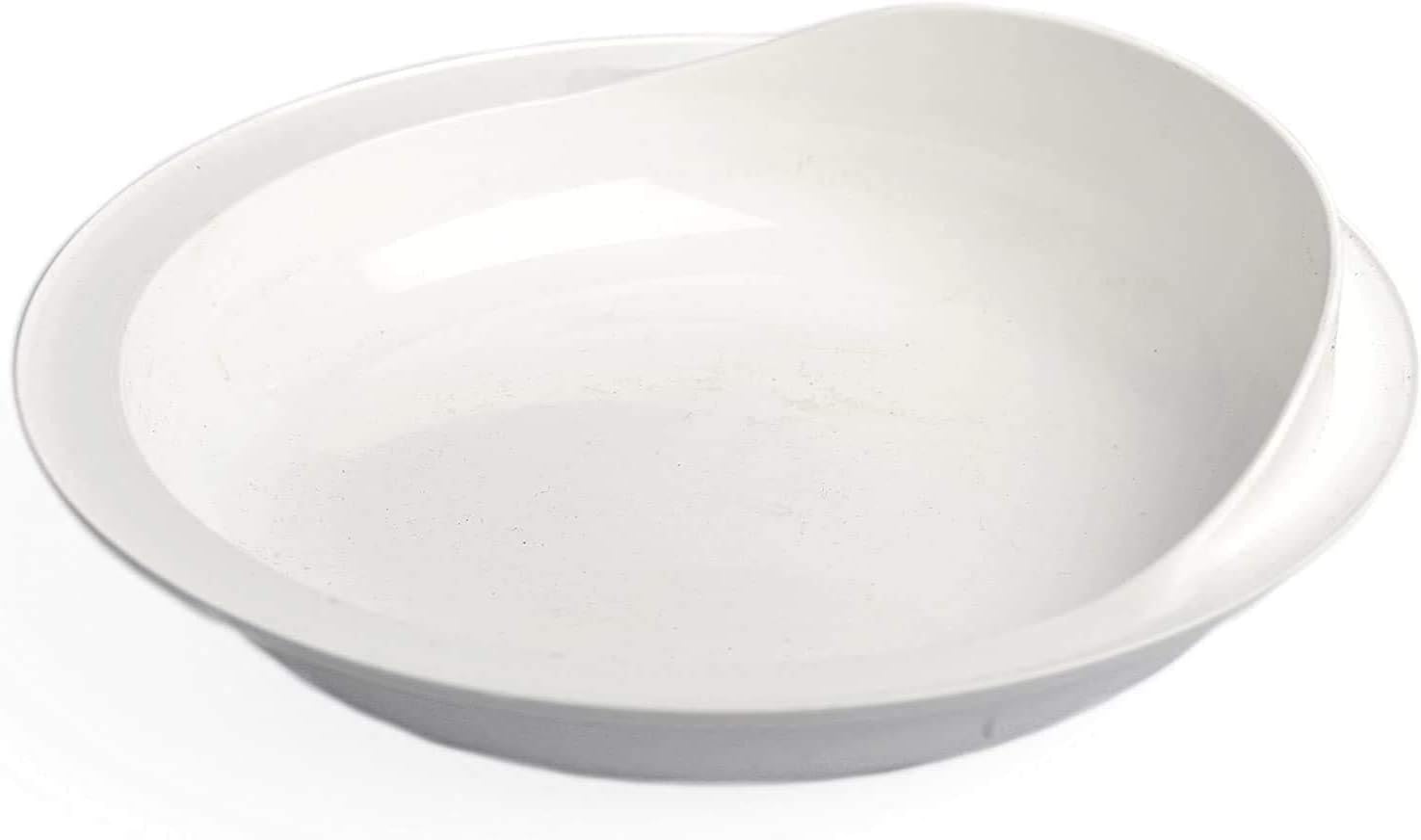
4. Providence Spillproof 9-Inch Scoop Plate
Best Value
Providence Spillproof 9-Inch Scoop Plate
High-low scoop plate with a low front edge and raised back wall — lets users scoop food onto a utensil with one hand without chasing it around the plate.
Price: $12.77 | Rating: 4.6/5 (1,437 reviews) | Diameter: 9 inches
SHOP
Here's a problem nobody talks about until it happens to them: food fleeing the plate. When you have a tremor, each attempt to scoop food onto a fork imparts lateral force — and on a flat plate, that force sends peas rolling, rice scattering, and mashed potatoes ending up on the tablecloth.
The scoop plate solves this with architecture. The back and sides are raised about an inch; the front edge is nearly flat. You push food against the high wall, and it has nowhere to go but onto your utensil. It's the same principle as a pusher tool — but built into the plate itself, so there's nothing extra to hold.
Providence has been making adaptive dining ware for 40 years, and it shows. The plate is dishwasher-safe, microwave-safe, and practically indestructible. At $12.77, it's the cheapest item on this list and arguably the most impactful. You can spend $200 on a lift chair, but if someone can't get food onto a fork, the chair doesn't help at mealtime.
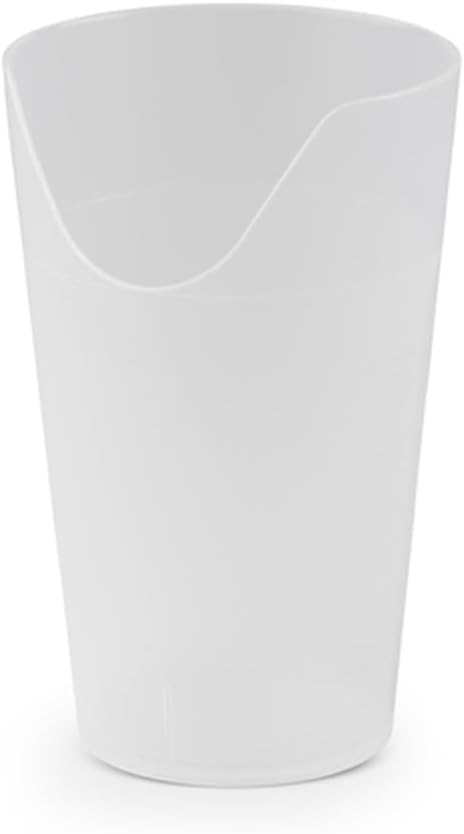
5. Providence Spillproof Nosey Cup 8 oz
Specialty
Providence Spillproof Nosey Cup 8 oz
Angled nosey cup with cutout rim that lets users drink without tilting their head back — reduces choking and aspiration risk for dysphagia and limited neck mobility.
Price: $10.99 | Rating: 5.0/5 | Capacity: 8 oz
SHOP
Drinking seems simple until your neck won't extend. For people with cervical arthritis, post-stroke rigidity, or dysphagia (difficulty swallowing), tipping the head back to drain the last third of a glass is either impossible or dangerous — aspiration pneumonia is a leading cause of hospitalization in elderly populations.
The Nosey Cup's name comes from its shape: the cutout accommodates the nose and eyeglasses, so the cup can be tilted while the head stays upright. The liquid reaches the mouth by cup design, not neck extension. It's an eight-dollar piece of plastic that prevents a forty-thousand-dollar hospital stay.
Research from the National Institutes of Health confirms that upright drinking posture significantly reduces aspiration risk in adults with dysphagia compared to extended neck posture.
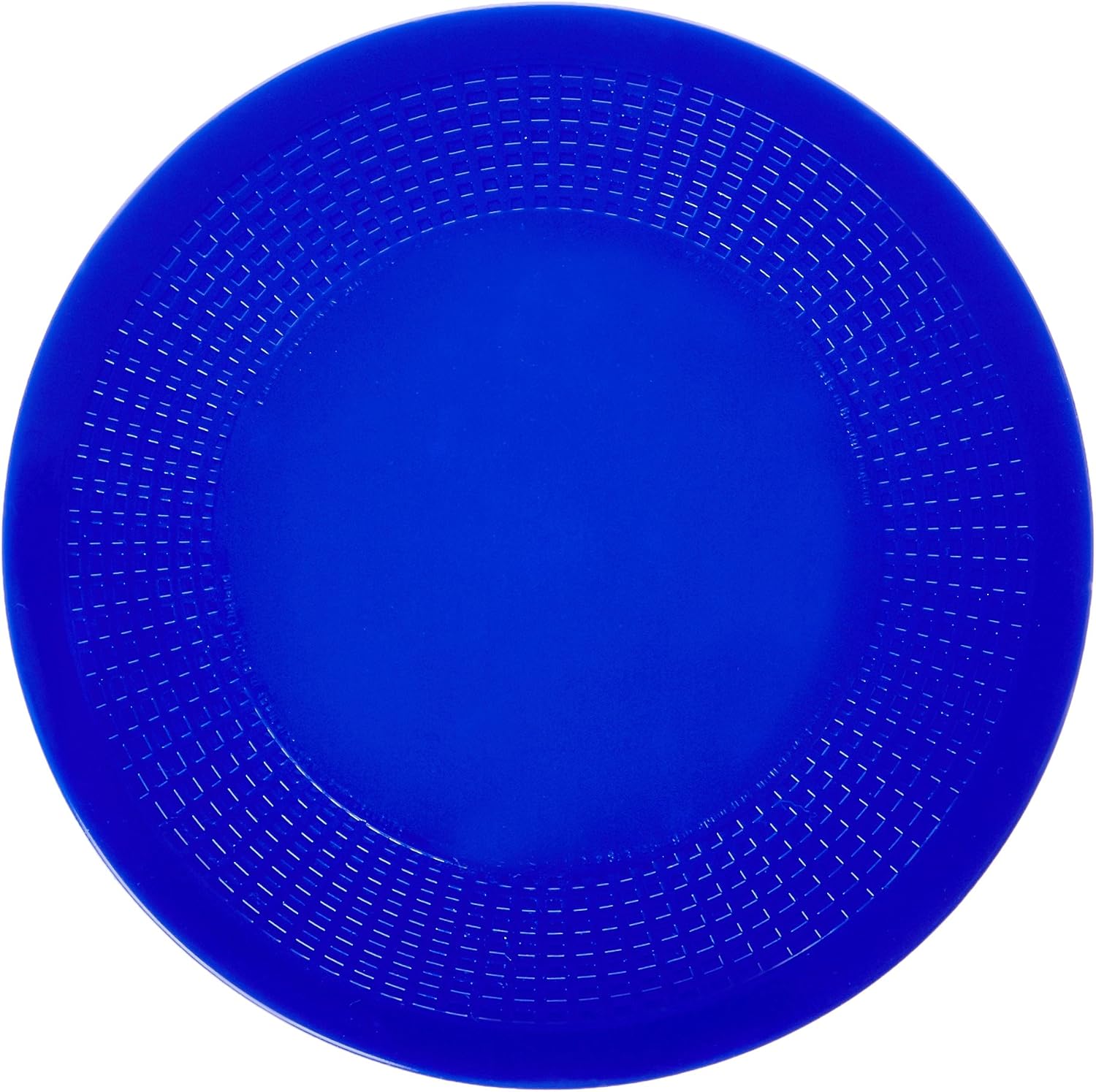
6. Dycem Non-Slip Mat
Caregiver Essential
Dycem Non-Slip Mat
Textured non-slip pad that anchors plates, bowls, and cups to the table — prevents sliding during one-handed eating and stabilizes items for caregivers.
Price: $17.38 | Rating: 4.7/5 (241 reviews) | Size: 7.5 inches
SHOP
Dycem is the most boring product on this list and the one caregivers buy most often. It's a mat. A sticky mat. That's it.
But here's what it does: it turns any table into a grip surface. Place the scoop plate on it, and the plate stays put while food is being scooped. Place a glass on it, and a tremor-induced nudge doesn't send it sliding off the table. Place a cutting board on it, and the one-handed rocker knife user can cut without the board traveling.
Dycem isn't adhesive — it uses surface tension from a uniquely textured polymer. It works wet or dry, washes with soap and water, and lasts for years. Occupational therapy clinics stock it by the case. If you're buying adaptive utensils for the first time, buy a Dycem mat alongside them — the tools work better when the surface holds still.
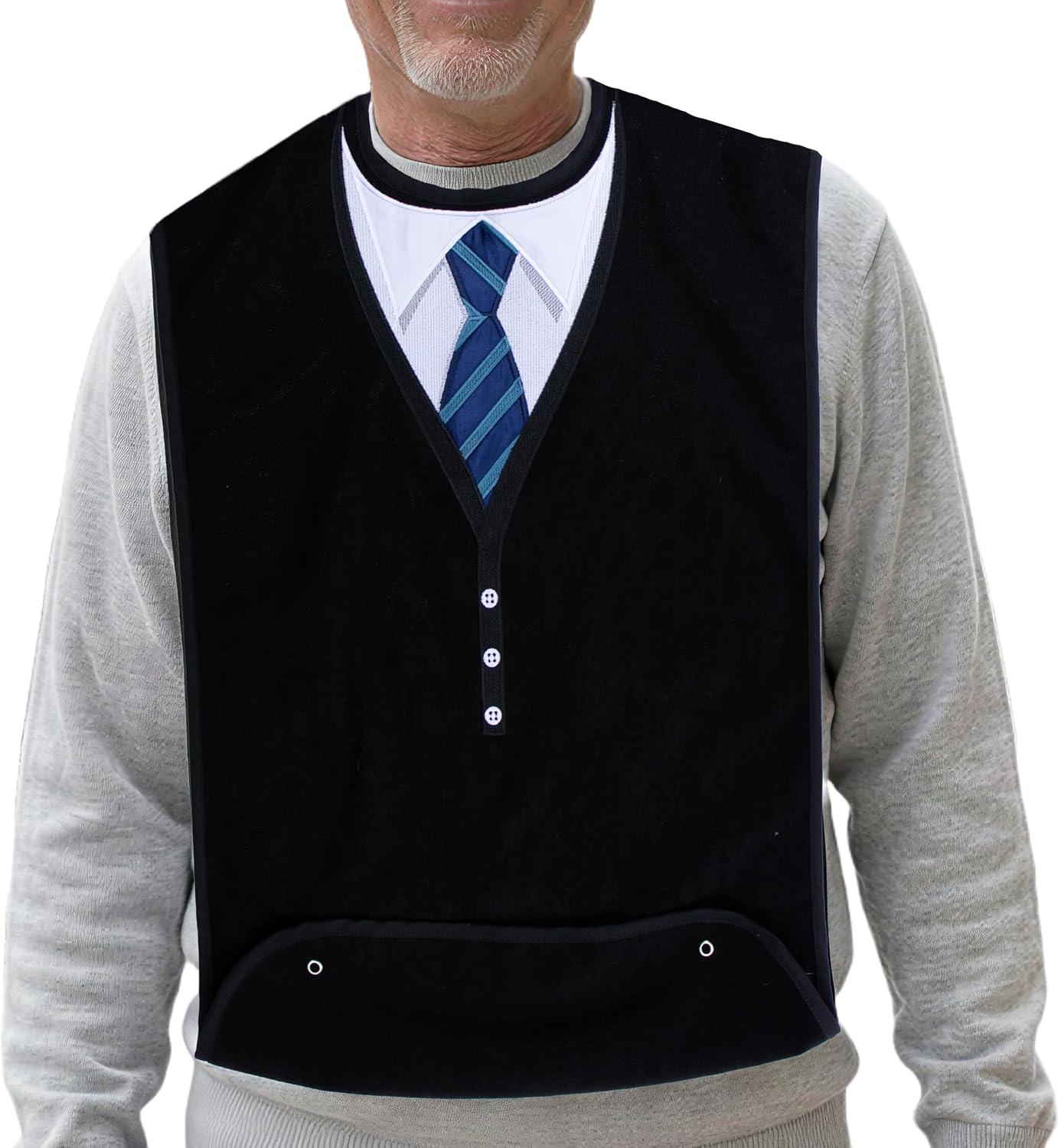
7. Reusable Adult Bibs
Amazon Verified
Reusable Adult Bibs
Waterproof wipe-clean adult bib with crumb-catching pocket — protects clothing during meals without looking like a traditional baby bib.
Price: $21.99 | Rating: 4.5/5 (222 reviews) | Style: Waterproof, reusable
SHOP
Let's address the elephant in the room: nobody wants to wear a bib. The word itself carries a weight of infantilization that can make a proud adult refuse to eat rather than accept one.
But here's the reframe: it's not a bib. It's a dining apron. It's a clothing protector. It's the difference between changing your shirt after every meal and not. The crumb-catcher pocket is the practical genius — it catches food that misses the mouth, which means it doesn't end up on your lap, your chair, or your floor.
The psychological barrier is real, and the best approach is to reframe it as a choice rather than a necessity. "Would you prefer the navy or the burgundy protector?" works better than "You need to wear a bib now." The waterproof backing means soup spills bead up and wipe off — no laundry required mid-meal.
How to Choose Adaptive Utensils: A Quick Guide
Match the Tool to the Condition
Parkinson's or essential tremor: Weighted utensils (7oz+). The weight dampens involuntary movements through proprioceptive feedback. Start with the full set, add a rocker knife if cutting is affected.
Arthritis (reduced grip strength): Built-up or ribbed handles. The issue isn't tremor — it's the inability to maintain a secure hold. Look for oversized grips that don't require full hand closure.
Post-stroke (one-sided weakness): Rocker knife + scoop plate + Dycem mat. This trio lets a person eat an entire meal with one hand without food escaping.
Dysphagia or neck mobility issues: Nosey cup. Eliminates the need to extend the neck, which is the single most dangerous movement for aspiration.
Start Simple, Add as Needed
Don't buy seven products at once. Start with the one that addresses the most frustrating part of the meal. For most people, that's the utensil itself — if food won't stay on the fork, nothing else matters. Add the scoop plate next, then the Dycem mat, then the bib if clothing protection becomes an issue.
Involve the User in the Decision
This sounds obvious, but it's the most common mistake caregivers make. Adaptive tools only work if the person actually uses them — and a tool chosen for someone often becomes a tool rejected by someone. Show them options. Let them hold them. Ask which feels right. The two minutes spent on this conversation saves two months of unused utensils in a drawer.
FAQ
Q: Do weighted utensils really help with Parkinson's tremors?
A: Yes. Research published in the Journal of NeuroEngineering and Rehabilitation shows that added weight (5-8 oz) reduces tremor amplitude by providing proprioceptive feedback that calms involuntary movements. The effect is most noticeable for essential tremor and Parkinson's resting tremor during eating.
Q: What is a rocker knife and who benefits from it?
A: A rocker knife has a curved blade that cuts food with a gentle rocking motion using one hand. It benefits people with hemiplegia (post-stroke), arthritis, weak grip, or any condition that makes two-handed cutting difficult.
Q: Are adaptive utensils covered by Medicare or FSA/HSA?
A: Many adaptive dining utensils are FSA/HSA eligible when purchased for a diagnosed medical condition. Medicare Part B may cover durable medical equipment with a doctor's prescription, though everyday utensils typically require self-pay. Check your specific plan for coverage details.
Q: What's the difference between weighted and built-up utensils?
A: Weighted utensils add mass to the handle to dampen tremors — ideal for Parkinson's and essential tremor. Built-up utensils have thicker, easier-to-grip handles for arthritis and weak grip strength — they're lighter but require less dexterity to hold.
The Bottom Line
Adaptive utensils are not about making peace with limitations. They're about refusing to accept them. The right fork, the right plate, the right knife — these are tools of resistance against a body that's not cooperating. Every meal eaten independently is a small victory, and small victories compound into a life that still feels like your own.
If you're just starting, my recommendation is the weighted utensil set ($54.99) for tremors, the scoop plate ($12.77) for one-handed eating, and a Dycem mat ($17.38) to hold everything steady. That's $85 for a complete adaptive dining setup — less than the cost of one delivered meal per week for a month.
For the full range of senior dignity products — from grab bars to lift recliners to touchless faucets — visit our Senior Dignity & Accessibility hub.
Reviewed by Adele, Founder & Senior Gift Curator. Products verified via live Amazon search August 2026. Prices and availability subject to change. This article contains affiliate links — see our privacy policy for disclosure details.
Watch & Learn: Video Guides
 ►
►
Watch: Adaptive Utensils for Tremors Review
 ►
►
Watch: Best Adaptive Utensils for Hand Tremors